Basic Crypto Education
What Is Crypto?
Crypto, or cryptocurrency, is a type of digital and encrypted asset designed to transfer value over the internet. These currencies are exchanged between users using cryptographic algorithms and, unlike traditional currencies that are issued and controlled by governments, they operate on decentralized networks based on blockchain technology. There is no central authority governing them, and transactions are verified by a network of nodes and validators. Due to strong cryptography, they prevent fraud and counterfeiting.
The Difference Between Digital Currencies and Fiat Money
Traditional or fiat currencies (such as the dollar, euro, and rial) are printed and issued by governments, and their transactions can be reversed and are linked to identifiable individuals. In contrast, cryptocurrency transactions, once recorded on the blockchain, are irreversible, and users’ identities remain hidden; only the public wallet address and balance are visible. Additionally, cryptocurrencies allow users to transfer assets anywhere in the world without geographical limitations or intermediaries, benefiting from higher speed and security.
History of Cryptocurrencies
The digital money movement began in the early 2000s, but the first successful cryptocurrency that utilized blockchain technology was Bitcoin, introduced in 2009. It was created by an anonymous individual or group under the pseudonym Satoshi Nakamoto with the aim of eliminating financial intermediaries and creating a decentralized payment system.
Bitcoin remains the most valuable cryptocurrency in the market and has inspired thousands of other projects. Projects launched after Bitcoin, with different features or objectives, are known as altcoins.
Blockchain Technology
To understand how crypto works, one must first understand blockchain. Blockchain is a distributed and immutable ledger that transparently records and stores all transactions. In this system, user account information and transactions are stored in blocks, and each block contains the hash of the previous block. This feature makes any change to past information easily detectable and, in practice, makes data manipulation nearly impossible. All network participants have a copy of this ledger, and as each new block is added, they update their version; thus, the ledger operates without the need for a central authority.
Consensus Algorithms
For blocks to be validly added to the chain, network nodes must agree on the validity of transactions; this process is called “consensus.” Bitcoin uses the “Proof of Work” (PoW) algorithm, which requires high energy consumption and computational power. In this process, miners solve complex equations to produce new blocks, and the winning miner receives the block reward. Other algorithms such as “Proof of Stake” (PoS) also exist, where users secure the network by locking their tokens and, instead of consuming energy, use their capital as collateral.
Wallets and Private Keys
To store and manage cryptocurrencies, a wallet is required. Wallets consist of a pair of private and public keys; the private key is like a password that provides full access to assets and must remain confidential, while the public key is similar to a bank account number and is used to receive funds. Wallets are divided into two main types:
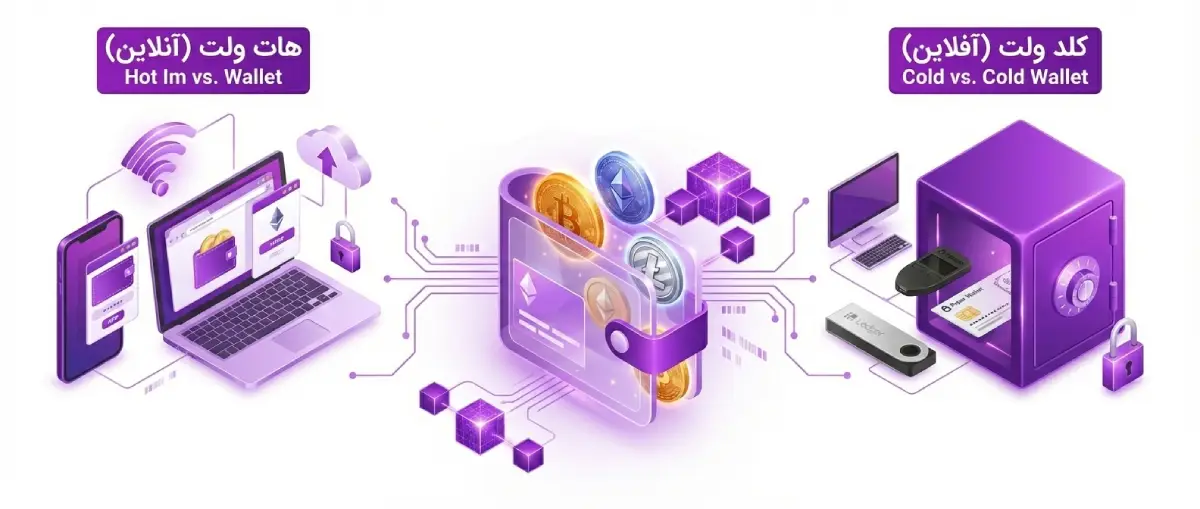
Hot Wallet: A software or application connected to the internet, such as mobile or desktop wallets. It offers easy access and is suitable for daily transactions but is less secure than a cold wallet.
Cold Wallet: A hardware device or paper wallet that is not connected to the internet. It is suitable for long-term storage of assets and offers much higher security, as the risk of hacking is lower.
Categories and Types of Cryptocurrencies
Cryptocurrencies can be categorized based on their infrastructure or use case:
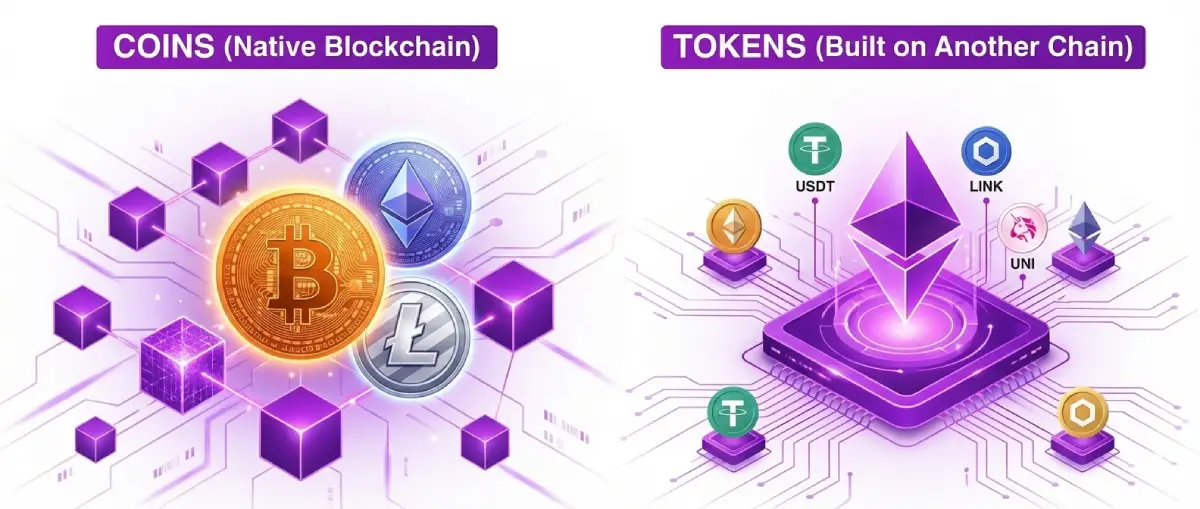
Coins: Currencies with their own blockchain, such as Bitcoin and Ethereum. Coins are often used for payments and as a store of value and may grant network ownership to holders.
Tokens: Built on other blockchains and have various uses, from project governance to access to specific services. ERC-20 tokens on Ethereum are a well-known example.
Stablecoins: Tokens whose value is pegged to a stable asset (such as the dollar or gold) and are used to reduce market volatility.
Meme Coins: Currencies primarily formed around humor and community; the most famous example is Dogecoin. These assets carry high risk and volatility.
Altcoins: Generally include any cryptocurrency other than Bitcoin and are often created to improve upon or add new features compared to Bitcoin.
Examples of Well-Known Cryptocurrencies
The list below presents some of the most famous cryptocurrencies along with their year of introduction and key features.
Bitcoin (BTC): Introduced in 2009, it pioneered the cryptocurrency movement and uses the Proof of Work algorithm. Its main goal is decentralizing the monetary system and creating an independent digital currency.
Ethereum (ETH): Launched in 2015 with support for smart contracts and decentralized applications, providing a platform for building decentralized apps and developing DeFi.
XRP (XRP): Introduced in 2012 with the goal of enabling fast and low-cost international asset transfers, focusing on collaboration with financial institutions and improving cross-border payment systems.
Litecoin (LTC): Launched in 2011 to address Bitcoin’s scalability limitations, offering faster transaction speeds and lower fees to improve confirmation times.
Dogecoin (DOGE): Introduced in 2013, a popular memecoin with a strong community, often used for small payments and community-supported charitable activities.
Advantages and Benefits of Cryptocurrencies
Cryptocurrencies offer several advantages over traditional financial systems:
- Decentralized and Without Intermediaries: Network control is in the hands of users, and no government or bank can confiscate or freeze your assets.
- Irreversibility: Once recorded on the blockchain, transactions are final and cannot be reversed unless the recipient sends the funds back.
- Privacy Protection: User identities remain hidden in blockchain transactions; only wallet addresses and balances are visible.
- Fast and Low-Cost Transfers: Assets can be transferred at any time to anywhere in the world with low fees and within minutes.
- Limited and Predefined Supply: Many cryptocurrencies have a capped supply (for example, 21 million units for Bitcoin), which helps prevent inflation and continuous devaluation.
Applications of Cryptocurrencies
Blockchain technology and cryptocurrencies are not limited to money transfers; some of their most important applications include:
- International Payments and Remittances: Fast and low-cost money transfers worldwide without the need for banks.
- DeFi (Decentralized Finance): Creation of decentralized financial services such as lending, staking, and yield farming without banks or financial institutions.
- Smart Contracts: Automatic execution of agreements between parties without intermediaries; these contracts are immutable and transparent.
- Digital Ownership and NFTs: The ability to register and transfer ownership of artworks, music, in-game items, and other digital assets as non-fungible tokens.
- Industrial and Supply Chain Applications: Tracking goods and services in supply chains and recording transparent data to prevent fraud.
Blockchain
in Simple Terms
In recent years, the name “blockchain” has been widely heard. This technology plays a role in various fields—from digital currencies to supply chains and healthcare. But what exactly is blockchain? Why is it considered so revolutionary, and how does it establish trust among strangers without relying on a bank or central authority? In this article, we aim to explain in simple language the nature and structure of blockchain, its history, features, types of networks, advantages and disadvantages, and its applications.
What Is Blockchain?
Blockchain can be described as a distributed digital ledger in which data is stored as a chain of blocks. Each block contains a set of transactions or information and, once completed and verified, is connected to the previous block, forming an immutable chain. This data is distributed among all network members and, through cryptography and decentralization, tampering or hacking becomes nearly impossible.
In other words, blockchain is like an accounting ledger that, instead of being stored in a central bank, is held by all participants. Everyone can verify the accuracy of the data, but no one can change it without permission.
A Brief History of Blockchain
The conceptual roots of blockchain date back to the 1990s. In 1991, Stuart Haber and Scott Stornetta developed a method for digital timestamping to preserve the immutability of digital documents.
Later, in 2008, an anonymous individual or group under the name Satoshi Nakamoto introduced the first public blockchain for Bitcoin, bringing a previously theoretical concept into practice.
This innovation paved the way for digital currencies and the development of later blockchain generations. The second generation of blockchain (Blockchain 2.0), introduced by Ethereum, enabled the execution of smart contracts. Today, blockchain technology is transitioning toward more energy-efficient algorithms such as Proof of Stake (PoS).
How Does Blockchain Work?
Block and Chain Structure
Each block contains:
Data (such as transactions)
A random value called a “nonce”
A cryptographic value called a “hash”
The hash of each block is calculated using cryptographic algorithms and stored in the next block. Therefore, if someone alters the data of a block, subsequent hashes change as well, invalidating the chain.
Each block has limited capacity; once filled, a new block is created and added to the chain.
Distributed Ledger and Nodes
Blockchain does not rely on a single ledger. Instead, copies are stored across thousands of “nodes” in the network.
This ensures that:
All participants have access to the data
Transactions can be independently verified
No single authority can control or alter the chain
To add a new block, the network must reach agreement through a consensus mechanism such as Proof of Work (PoW) or Proof of Stake (PoS).
The Role of Hashing and Cryptography
The hash of each block functions like its fingerprint. Even a small change in the block’s data completely alters its hash, breaking its connection to the chain.
Combining the current block’s hash with the previous block’s hash ensures chain integrity and security. Along with public and private key cryptography, this guarantees that only the private key holder can sign transactions, while the network can verify their authenticity.
Main Components of Blockchain
Block: The basic storage unit containing data, nonce, and hash.
Hash: The output of a cryptographic function that uniquely identifies each block and reveals any data modification.
Distributed Ledger: A complete copy of the chain stored across all network nodes, creating transparency and trust.
Node: A computer that stores a copy of the ledger and participates in transaction validation.
Consensus Mechanism: An algorithm ensuring all nodes agree on the ledger’s final state (e.g., PoW, PoS).
Smart Contract: Programs executed on the blockchain that automatically enforce agreements without human intervention.
Key Features of Blockchain
Immutability and Transparency
Once a block is added to the chain, altering or deleting it is extremely difficult. All users hold a copy of the ledger and can view transaction history, ensuring transparency and trust.
Decentralization
Unlike traditional systems controlled by central banks or institutions, blockchain is managed by a network of nodes. This reduces censorship risks and enables peer-to-peer transactions.
High Security
Advanced cryptography combined with data distribution makes hacking or altering data nearly impossible. Nodes must reach consensus before any new block is recorded.
Speed and Efficiency
Traditional cross-border transfers may take days. Blockchain can reduce this to minutes by removing intermediaries. However, speed depends on the network type and consensus algorithm.
Types of Blockchain Networks
Public Blockchain
Open to everyone. Anyone can join, view data, and participate in transaction validation. These networks are highly transparent but require significant computational power and energy. Examples include Bitcoin and Ethereum.
Private Blockchain
Managed by a specific organization or limited group. Access and validation are controlled. Faster than public networks and suitable for companies requiring privacy.
Consortium (Collaborative) Blockchain
A hybrid model managed jointly by multiple organizations. Widely used in banking, finance, and supply chain industries.
Advantages and Disadvantages of Blockchain
Accuracy and Trust
Advantages:
Disadvantages:
Cost Reduction
Advantages:
Disadvantages:
Security and Privacy
Advantages:
Disadvantages:
Transparency and Accessibility
Advantages:
Disadvantages:
Applications of Blockchain
Digital Currencies and Money Transfer
Bitcoin and other cryptocurrencies use blockchain for secure, fast, and direct value transfer, enabling low-cost cross-border transactions.
Supply Chain and Product Tracking
Companies can record all production, transportation, and distribution stages, ensuring transparency and preventing fraud.
Healthcare and Medical Records
Medical data stored on blockchain allows secure and controlled access while preserving patient privacy.
Electronic Voting
Blockchain-based voting systems ensure accurate vote recording and counting while preventing manipulation and preserving voter anonymity.
Document and Ownership Registration
Registering property, vehicles, and other assets on blockchain ensures secure and transparent transfers and prevents forgery.
Decentralized Finance (DeFi) and NFTs
Smart contracts enable lending, borrowing, and trading without banks. NFTs allow unique digital ownership of art, music, and in-game assets.
Difference Between Coin and Token
In the broad cryptocurrency market, the terms coin and token are frequently used. Many newcomers use these two terms interchangeably, while in reality there are fundamental differences between them. Understanding these differences is especially important for investors and developers, as each plays a distinct role within the blockchain ecosystem.
In this article, we will explain in simple terms the definition of coins and tokens, their features, types, use cases, and the key differences between them.
What Is a Coin?
A coin is a cryptocurrency that has its own independent blockchain and functions as the native currency of that network. Coins operate independently and run on their own infrastructure.
Key Characteristics of Coins:
Independent Blockchain:
Each coin has its own distributed ledger. This blockchain is like an independent country with its own rules and economic system.
Transaction Fee Payment:
Native coins are used to pay transaction fees and reward miners or validators on the network.
Store of Value:
Many coins (such as Bitcoin) have limited supply and function as a store of value or “digital gold.”
Complex Creation Process:
Creating a new coin requires building a blockchain from scratch, which demands technical expertise, financial resources, and a community of nodes.
Well-known examples of coins include Bitcoin (BTC), Ether (ETH), and Litecoin (LTC). In addition to transferring value, some coins are also used to execute smart contracts and support decentralized applications.
What Is a Token?
A token is a digital asset that does not have its own blockchain. Instead, it is built on top of another blockchain’s infrastructure.
Tokens are created using smart contracts on host blockchains such as Ethereum or Binance Smart Chain.
Main Features of Tokens:
Dependence on a Host Blockchain:
Tokens inherit their security, speed, and transaction costs from the blockchain they are built on.
Ease of Creation:
Creating a token using standards like ERC-20 or BEP-20 is much easier than building a new blockchain.
Diverse Use Cases:
Tokens can represent real or digital assets, governance rights, access to services, or other forms of value. Tokens such as Tether (USDT), USDC, and UNI are widely used in the crypto market.
Fees Paid in Native Coin:
To transfer tokens, transaction fees must be paid using the native coin of the host blockchain. For example, transferring USDT on Ethereum requires paying fees in ETH.
Types of Tokens
Tokens can be categorized based on their nature and function. The most important types include:
Fungible Tokens
These tokens are interchangeable and divisible; each unit has the same value as another. The ERC-20 standard on Ethereum is one of the most common standards for fungible tokens.
Non-Fungible Tokens (NFTs)
Each unit of these tokens is unique and non-interchangeable. NFTs are used to represent ownership of unique digital or physical assets such as artwork, collectibles, or in-game items.
Utility Tokens
These tokens provide users access to specific products or services within a platform. For example, the BAT token in the Brave browser is used to reward users and advertisers.
Governance Tokens
Holders of these tokens have voting rights in future decisions of a project or protocol. The UNI token in the decentralized exchange Uniswap is an example.
Security Tokens
These tokens represent ownership or shares in real-world assets such as real estate or company equity and are usually subject to securities regulations.
Stablecoins
Although some stablecoins are technically native coins, many are issued as tokens on host blockchains to maintain a stable value relative to fiat currencies. USDT and USDC are well-known examples.
Key Differences Between Coin and Token
Infrastructure
Primary Purpose
Coin: Used as the native currency of a network and as a store of value.
Token: Offers diverse utilities such as service access, governance, ownership, and more.
Creation Method
Coin: Requires building a blockchain network from scratch, which is technically complex.
Token: Created through smart contracts on a host blockchain with relative ease.
Transaction Fees
Wallets and Addresses
Security
Creation Standards
Coin: No universal standard; each coin follows its own protocol.
Token: Follows defined standards such as ERC-20, BEP-20, or TRC-20.
Price Volatility
Further Explanation of the Differences
1. Structure and Purpose
Coins function similarly to money and serve as a store of value and payment method within their network. Tokens are designed for specific use cases and cover a broader range of functionalities, from governance and ownership rights to decentralized applications.
2. Creation Process
Creating a coin requires designing and implementing a new blockchain, selecting a consensus mechanism, and attracting nodes to secure the network. In contrast, developing a token simply involves writing a smart contract on an existing blockchain.
3. Fees and Wallets
To transfer tokens, you must hold some of the host blockchain’s native coin to pay transaction fees. Coins, however, use their own currency for fees. Tokens share the address structure of their host blockchain.
4. Security and Network Role
Coins are directly tied to maintaining network security and incentivizing participation in consensus. Tokens primarily focus on providing utility and economic incentives within a project.
5. Investment Perspective
Choosing between a coin and a token depends on your goals, the project, and investment strategy. Neither is inherently superior. Coins often have stronger infrastructure support, while tokens may offer higher short-term return potential.
How to Identify a Coin vs. a Token
Use Reliable Sources:
Websites like CoinMarketCap or CoinGecko provide detailed information about digital assets.
Layer 1 (L1) Projects:
Assets listed as Layer 1 projects are typically coins.
Blockchain Dependency:
If a digital asset does not have its own blockchain, it is classified as a token.
Important Tips for Investors
Do Not Forget Network Fees:
When transferring tokens, always keep enough of the host blockchain’s native coin in your wallet to pay transaction fees.
Choose the Correct Network:
Many tokens exist on multiple blockchains. Always ensure the sender and receiver networks match exactly, as selecting the wrong network may result in permanent loss of funds.
Be Aware of Scam Projects:
Since creating tokens is relatively easy, the space can be exploited for fraudulent projects. Before investing, carefully examine the project’s utility and the background of the development team.
Comparison of Crypto Transfer Networks: From ERC-20 to SPL
In the world of cryptocurrencies, every token requires a specific network for transfers. These networks—often referred to as token standards—are sets of rules that define how tokens are issued, transferred, and interact within a blockchain.
Choosing the correct network for sending or receiving crypto not only affects transaction cost and speed, but also prevents the risk of permanently losing funds.
In this article, we compare well-known networks such as ERC-20 (Ethereum), TRC-20 (Tron), BEP-20 (Binance Smart Chain), SPL (Solana), as well as Omni and BEP-2, examining their features, fees, and practical use cases.
Token Networks and Standards in Simple Terms
A token standard is a set of rules that defines how tokens are created, issued, and transferred on a blockchain.
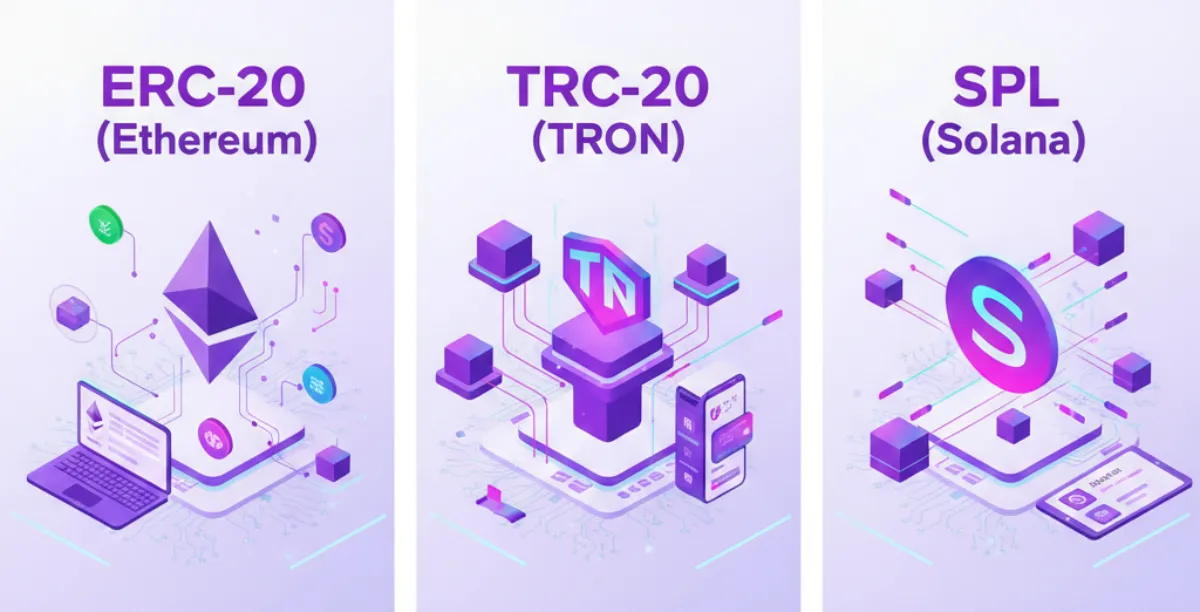
For example, ERC-20 is a standard defined on the Ethereum blockchain, and thousands of tokens are built and transferred using this framework. These standards allow wallets and exchanges to seamlessly support different tokens while enabling developers to easily build smart contracts.
A blockchain can support multiple standards. For instance, Ethereum offers ERC-20, ERC-721, and ERC-1155.
Ethereum Network – ERC-20 Standard
Ethereum is the second-largest blockchain after Bitcoin and one of the first platforms to introduce smart contracts and programmable tokens.
ERC-20 (Ethereum Request for Comment 20) was proposed in 2015 by Fabian Vogelsteller to standardize token creation and transfers. It defines how tokens are sent, received, and how total supply and other parameters are managed. Most major tokens are built on Ethereum.
Advantages and Features
Wide Support:
Ethereum is supported by most major exchanges and wallets. As a result, ERC-20 tokens have high liquidity.
Advanced Smart Contracts:
With a large developer community and multiple programming language supports, Ethereum hosts a wide range of decentralized applications (dApps).
High Security:
Due to its large number of nodes and validators, attacking the network is extremely difficult.
Disadvantages
High and Variable Fees:
Ethereum transaction fees typically range between $3 and $30 and increase during network congestion.
Moderate Speed:
Transaction confirmations vary from 30 seconds to several minutes depending on traffic.
Tron Network – TRC-20 Standard
The Tron blockchain launched in 2017 to address Ethereum’s limitations and introduced the TRC-20 standard for token creation and transfers.
Tron uses a Delegated Proof of Stake (DPoS) consensus mechanism, where validators are elected by token holders.
Features and Advantages
High Speed:
Block time is approximately 3 seconds, meaning transactions are confirmed within seconds.
Low or Near-Zero Fees:
TRC-20 transfers are extremely inexpensive and sometimes nearly free on exchanges.
Distinct Addresses:
TRC-20 wallet addresses start with a capital T, making them easy to identify.
Ethereum Compatibility:
Tron’s virtual machine supports Solidity, making smart contracts compatible with Ethereum.
Disadvantages
More Centralized:
DPoS with a limited number of validators may lead to higher centralization.
Relatively Lower Security Compared to Ethereum:
While secure, it is not considered as robust as Ethereum for very large holdings.
Use Case
TRC-20 is ideal for everyday transactions and fast, low-cost transfers. Many traders use it for transferring USDT.
Binance Smart Chain – BEP-20 Standard
Binance launched Binance Smart Chain (BSC) in 2019 as a faster and cheaper alternative to Ethereum.
It uses Proof of Staked Authority (PoSA) and produces blocks approximately every 3 seconds.
Features and Advantages
Very Low Fees:
Ethereum fees can be significantly higher than BSC. USDT transfer on BEP-20 has been around $0.12 compared to much higher fees on Ethereum.
High Speed:
Transactions are confirmed within seconds, similar to Tron.
Ethereum Compatibility:
BEP-20 addresses start with 0x, just like Ethereum. BSC is compatible with ERC-20 smart contracts, and many Ethereum tokens exist as pegged versions on BSC.
Disadvantages
Address Similarity with Ethereum:
Since both BEP-20 and ERC-20 addresses start with 0x, selecting the wrong network may result in lost funds.
Validator Centralization:
BSC has fewer validators compared to Ethereum, making it less decentralized.
Use Case
Due to low fees and high speed, BEP-20 is widely used in wallets like Trust Wallet and for projects needing Ethereum ecosystem compatibility.
Solana Network – SPL Standard
Solana was founded in 2017 by Anatoly Yakovenko to solve blockchain scalability issues.
It uses a unique Proof of History (PoH) mechanism combined with Proof of Stake (PoS), allowing transaction ordering before consensus.
Features and Advantages
Exceptional Speed and Scalability:
Solana can process thousands of transactions per second, with theoretical capacity reaching tens of thousands per second.
Minimal Fees:
Transaction costs are typically less than $0.01, making SPL one of the cheapest networks.
SPL Standard:
The Solana Program Library (SPL) enables creation and management of tokens with parallel execution for high throughput.
Growing Ecosystem:
Its speed and low cost make Solana attractive for DeFi, NFTs, and blockchain gaming.
Disadvantages
High Hardware Requirements:
Validators require powerful hardware, potentially increasing centralization.
Occasional Network Outages:
Due to complexity and high speed, Solana has experienced temporary shutdowns in the past.
Use Case
SPL is suitable for high-frequency transactions, fast dApps, and gaming. The SOL token is used for fees and staking.
Bitcoin Network – Omni
Before newer standards became popular, Tether (USDT) was first issued on the Omni Layer, built on Bitcoin.
Omni addresses start with 1 or 3, similar to Bitcoin addresses.
Slow Confirmation:
Transactions may take between 0.6 to 2 hours.
High Fees:
Fees are similar to Bitcoin’s, making it expensive.
Use Case
Omni is more suitable for large transfers with less urgency and is rarely used today for everyday transactions.
Binance Chain – BEP-2
BEP-2 is a token standard on the original Binance Chain.
Requires BNB to pay transaction fees.
Requires entering a MEMO for transfers.
Slightly more complex than BEP-20.
Less widely used today, as most projects migrated to BEP-20 on BSC.
How to Choose the Right Network
Choosing the appropriate network depends on several factors:
1. Token Type and Exchange/Wallet Support
Some tokens exist only on specific networks. For example, Ethereum transfers only on its own blockchain, while USDT is available on ERC-20, TRC-20, and BEP-20.
2. Transaction Fees
For small and frequent transfers, low-fee networks such as TRC-20 or BEP-20 are better. For very large amounts, Ethereum’s security may be preferable.
3. Confirmation Speed
Tron and BSC confirm transactions within seconds; Solana is even faster. Ethereum and Omni are slower.
4. Security and Decentralization
The greater the number of nodes and validators, the higher the network’s security and decentralization. For large holdings, established networks with strong security are recommended.
What Is a Wallet? The Difference Between Hot Wallet and Cold Wallet
The world of cryptocurrencies cannot function without a wallet. Contrary to popular belief, your crypto assets are not actually stored inside a software application or physical device. Your assets exist on the blockchain, and a wallet is simply a tool that manages access to them.
However, choosing the right type of wallet is extremely important, as it directly affects both security and ease of use. This guide explains in simple terms what a wallet is, how it works, and the differences between a Hot Wallet and a Cold Wallet.
How Does a Wallet Work?
Each wallet generates and stores a set of private and public keys. The public key is like your account number; others can know it to send you crypto. The private key is like a password and should only be in the possession of the owner. The private key is used to sign transactions and prove asset ownership, and if it is exposed or lost, control of the assets is lost. Therefore, the most important function of a wallet is to securely generate and store private keys.
Types of Wallets Based on Internet Connectivity
Based on internet connectivity, wallets are mainly divided into two categories:
Hot Wallet: Software connected to the internet that provides quick and easy access to cryptocurrencies. This category includes mobile wallets, desktop wallets, and web wallets. Hot wallets can be custodial (private keys stored on the provider’s server) or non-custodial (private keys remain with the user).
Cold Wallet: Devices or methods that store private keys offline. This category includes hardware wallets and paper wallets, and does not require constant internet connection.
Hot Wallet
A Hot Wallet is a program that runs on a computer, smartphone, or web browser and is connected to the internet for quick cryptocurrency management. In a Hot Wallet, private keys are stored and encrypted within the application, and the user can access their assets from anywhere with internet connection. Hot Wallets, due to their broad features and simple user interface, are the most popular choice for daily use. The main types are:
Desktop Version: Software installed on Windows, Mac, or Linux that stores private keys on the user’s computer. This type is usually non-custodial and more secure than web wallets.
Mobile Version: An app on Android or iOS that allows sending, receiving, and managing assets via a mobile device. Most mobile wallets support QR-code payments, purchasing and storing digital coins, and other financial services.
Web Wallet: An online service accessible through a browser. This type is less secure because keys are stored on the provider’s server, and is suitable for small amounts and temporary use.
Advantages of Hot Wallets
Accessibility and Ease of Use: Hot wallets provide fast and easy crypto transfers thanks to constant internet connection, making them suitable for daily transactions. Many have a user-friendly interface and do not require complex technical knowledge.
Support for Multiple Currencies and Features: Most software wallets support a large number of coins and tokens, offering features like swapping, built-in exchange, and staking.
Low or Free Cost: Hot wallets are usually free; you just need to download and install the software.
Easy Recovery: If the device is lost, the user can recover assets using the Seed Phrase or private key.
Disadvantages of Hot Wallets
-
Lower Security: Because they are connected to the internet, they are vulnerable to cyberattacks and malware.
-
Custodial Risk: If private keys are stored on the provider’s servers (custodial wallets), there is a risk of losing assets in case of hacking or company bankruptcy.
-
Dependency on Device or Service: If your phone or computer is damaged, or the provider’s server fails, access to assets becomes difficult.
-
Potential Blocking: Web and mobile versions can be blocked due to sanctions or exchange policies.
-
Not Suitable for Large Amounts: Due to lower security, it is recommended to keep only small amounts or assets needed for daily transactions in a Hot Wallet.
Cold Wallet
A Cold Wallet is a method of storing private keys offline and does not require continuous internet connection. This group includes two main subtypes:
Hardware Wallet: A physical device resembling a USB drive that stores private keys and must be connected to a computer or mobile device to sign transactions. Examples include Ledger and Trezor. During a transaction, the user enters the amount and destination address in the software, then confirms the transaction by entering a code on the device.
Paper Wallet: A sheet containing private and public keys printed as a QR Code or character string. This method is secure against cyberattacks but carries physical risks such as damage or loss, and is not suitable for daily use.
Advantages of Cold Wallets
Very High Security: Because private keys are stored offline and there is no internet connection, remote hacking risk is nearly zero.
Suitable for Long-term Investment: Cold wallets are the best option for storing large amounts of assets and long-term investments.
Full Control Over Assets: Hardware and paper wallets are non-custodial; only the user has access to the keys, and there is no intermediary.
Support for Multiple Currencies: Many hardware wallets support hundreds of coins and tokens, and software updates can add new assets.
Disadvantages of Cold Wallets
Cost and Accessibility: Unlike Hot Wallets, Cold Wallets are not free, averaging around $80, and are harder to use compared to software versions.
Complex Transaction Process: For each transaction, the physical device must be connected to a computer or mobile device and verified manually.
Lower Speed: Physical connection and manual verification make asset transfer slower, not suitable for instant or fast trading.
Risk of Physical Loss or Damage: If the hardware device or paper wallet is lost, damaged, or the Seed Phrase is unavailable, assets become permanently inaccessible.
Importance of Storage: Storing the device and Seed Phrase securely in a safe place is a critical responsibility for the user.
How to Choose the Right Wallet
Define Your Goal: For long-term investment and large amounts, choose a Cold Wallet (the most secure option), and for daily transactions and small amounts, a Hot Wallet is appropriate.
Check Key Ownership: Prefer non-custodial wallets to maintain full control of your private keys.
Compare Cost and Features: Hot Wallets are free and easy to use, while Cold Wallets require purchase and are more complex.
Keep Seed Phrase Secure: In both Hot and Cold Wallets, the Seed Phrase is the most critical element; write it down on paper and store it safely.
Combine Both Types: Many professional users store their main assets in a Cold Wallet and transfer only the daily required amount to a Hot Wallet.
Introduction to Cryptocurrency Market Risks
The cryptocurrency market has experienced significant growth in recent years, attracting millions of people to invest and trade in this space. However, high price volatility, lack of clear regulations, and widespread scams make investing in crypto associated with many risks.
1. Price Volatility Risk
The price of Bitcoin and other altcoins can change by tens of percent in a short period. While this volatility can be profitable, it also carries the risk of heavy losses. Hacker attacks or negative news can cause a cryptocurrency’s price to drop by 30% in just a few days.
Solution: Use stop-loss orders, determine risk-to-reward ratios, maintain a long-term perspective, and avoid emotional trading.
2. Liquidity Risk
Low liquidity means that the buying and selling volume of an asset is small, making it difficult to sell quickly at the desired price.
Solution: Before buying, investors should check the trading volume and liquidity of the cryptocurrency on reputable exchanges.
3. Regulatory and Legal Risk
The crypto market is not fully regulated in many countries, and laws are often unstable. Governments may limit or ban transactions, causing sudden price changes. Some Iranian users have experienced account freezes on foreign exchanges.
Solution: Follow news and new regulations, choose licensed exchanges, and comply with KYC (Know Your Customer) procedures.
4. Security and Hacking Risk
Network or Exchange Hacks: Hackers can steal user assets by attacking the network or exchange.
Fake ICOs: Some projects raise funds with promises of high returns but disappear after collecting money.
Fake Wallets and Malware: Installing untrusted or infected wallets can lead to loss of private keys.
Loss of Private Keys or User Error: Forgetting the private key or sending assets to the wrong address results in permanent loss.
Solution: Use hardware wallets, enable two-factor authentication (2FA), and avoid clicking suspicious links.
5. Fraud and Scam Risk
The crypto market is a hub for fraudsters:
Solution: Carefully check the project team’s background, source code, and whitepaper; consult experts; and do not trust unrealistic promises.
6. Market Manipulation and Pump-and-Dump Risk
In shallow crypto markets, whales and large players can manipulate prices through massive buy and sell orders. This creates artificial upward (pump) or downward (dump) waves, causing many small traders to incur losses.
Solution: Avoid blindly following unknown signals, focus on fundamental analysis and trading volume, and use stop-loss orders to prevent heavy losses.
7. Counterparty and Trust Liquidity Risk
Many new investors entrust their assets to unknown individuals or platforms. If these parties cannot return the principal or promised profits, irreparable losses occur. Projects or exchanges may also misuse user funds for corruption or money laundering.
Solution: Only trust platforms and individuals with licenses and a reputable history, and never hand over your entire capital to someone else.
8. Psychological (Emotional) Risk
Fear and greed often lead traders to make poor decisions:
Sudden price surges or drops trigger internal excitement, prompting hasty buying or selling.
Fear of missing out (FOMO) can push investors into projects without proper analysis.
Solution: Create a clear trading plan, set entry and exit points, adhere to stop-loss limits, and continuously educate yourself on emotional control.
9. Technological and Complexity Risk
Blockchain is a new technology still under development. Bugs, technical errors, 51% attacks, and complex smart contracts can cause financial loss. Inexperienced users may also find platforms and wallets difficult to use.
Solution: Improve technical knowledge, use reliable software, study project technical documents, and participate in specialized communities to reduce this risk.
10. Systemic and Macroeconomic Risk
The crypto market is connected to other financial markets like stocks and the global economy. Economic instability, global recessions, or large financial institution bankruptcies can reduce overall market value and trigger domino effects. For example, the collapse of major banks can cause an economic slowdown and impact the crypto market.
Solution: Diversify your portfolio across various assets (crypto, stocks, precious metals) and monitor global economic and political conditions to reduce systemic risk.
11. General Guidelines for Risk Management in Crypto
Risk management is a continuous process. The following suggestions come from professional traders’ experience and expert advice:
Research and Education (DYOR): Before investing, study the project, development team, use cases, and roadmap.
Portfolio Diversification: Spread investments across multiple assets to minimize the impact of a single asset’s risk.
Set Stop-Loss and Risk/Reward Ratios: Define stop-loss and profit targets before entering a trade and stick to them.
Control Emotions: Avoid emotional and excessive trading; follow your trading plan consistently.
Use Secure Wallets: Store long-term assets in hardware wallets and keep only short-term trading funds on exchanges.
Follow Laws and Regulations: Register with licensed exchanges and comply with your country’s regulations.
Avoid High Leverage: High leverage can multiply profits but also increase the risk of losing capital; use it only with experience.
Monitor News and Developments: Track economic, technological, and legal news to make smarter decisions.
Backup Keys Safely: Store private keys and Seed Phrases offline in a secure location; avoid emails or cloud storage.
Consult Specialists: When in doubt, consult independent analysts and financial advisors to benefit from their experience and knowledge.