
What is Bitcoin? A Complete Guide to the First Digital Currency in the World
Bitcoin is the first digital currency in the world to gain widespread use. With Bitcoin, individuals can securely and directly send digital money to each other over the internet.
Bitcoin was created by an individual or group under the pseudonym Satoshi Nakamoto, who introduced this technology in a whitepaper in 2008. The idea behind Bitcoin is simple yet powerful: a fully digital form of money that enables secure, peer-to-peer (P2P) transactions over the internet.
Unlike services such as Venmo or PayPal, which rely on the traditional financial system, bank accounts, and intermediary permissions to transfer money, Bitcoin is decentralized. This means that two people anywhere in the world can send Bitcoin to each other without the involvement of a bank, government, or any central authority.
All Bitcoin transactions are recorded on the blockchain, a system similar to a bank ledger that tracks money in and out. Simply put, the Bitcoin blockchain is a permanent record of all transactions ever made with Bitcoin.
However, unlike a bank ledger, the Bitcoin blockchain is distributed across the entire network. No company, country, or third party controls it, and anyone can participate as part of this network.
The total number of Bitcoins will always be limited to 21 million units. Therefore, Bitcoin is a type of digital money that cannot be inflated or manipulated in terms of supply.
To use Bitcoin, you don’t need to buy a whole coin; you can purchase just a fraction of a Bitcoin, as much as you need.
Key Questions
What is BTC?
BTC is the abbreviation for Bitcoin.
Is Bitcoin a cryptocurrency?
Yes, Bitcoin is the first globally accepted digital currency. Simply put, a cryptocurrency is money that exists entirely in digital form.
What is the simple definition of Bitcoin?
Bitcoin is a decentralized digital currency used to conduct encrypted, peer-to-peer transactions without the need for a central bank.
How much is Bitcoin worth?
The price of Bitcoin is constantly changing and can be viewed on websites like Coinbase.
Is Bitcoin an investment opportunity?
Like any other asset, you can make a profit by buying Bitcoin at a low price and selling at a higher price—or incur a loss if the market moves against you.
At what price did Bitcoin start?
In early 2010, each Bitcoin was worth less than one US cent. In the first quarter of 2011, its price surpassed one dollar. By late 2017, Bitcoin’s price had reached nearly $20,000, and in November 2021, it reached an all-time high of approximately $64,899.
Bitcoin in Simple Terms
Bitcoin is a decentralized digital currency used to conduct encrypted, direct transactions between individuals without the need for a central bank.
Bitcoin Fundamentals
Since the creation of Bitcoin, thousands of new digital currencies have entered the market, yet Bitcoin (BTC) remains the largest digital currency in the world in terms of market value and trading volume.
Depending on Your Goal
Bitcoin can serve different purposes depending on your objectives, including:
- An investment tool
- A store of value similar to gold
- A method for transferring value globally
- Or even a way to explore an emerging technology
Bitcoin is a native currency of the internet. Unlike government-issued currencies like the US dollar or the euro, Bitcoin enables online money transfers without intermediaries such as banks or payment companies. Removing these intermediaries allows money to move faster, cheaper, and under complete control of the individual.
Bitcoin is legal in many countries and can be held, traded, and spent—from booking travel to making charitable donations. Companies such as Microsoft and Expedia have also accepted Bitcoin as a payment method.
Is Bitcoin Considered Money?
Bitcoin has been used as a medium of exchange, a store of value, and a unit of account—all characteristics of money. The difference is that Bitcoin exists solely digitally; there is no physical version in the real world.
Who Created Bitcoin?
To understand how Bitcoin works, it’s helpful to start at its origin. The question of who created Bitcoin is one of the most intriguing in technology and finance; over a decade after its invention, and despite extensive investigations by journalists and the crypto community, the creator’s identity remains unknown.
The fundamental principles of Bitcoin were first introduced in a whitepaper published in late 2008 by an individual or group known under the pseudonym Satoshi Nakamoto.
This whitepaper wasn’t the very first concept of digital money based on cryptography or computer science—even earlier ideas were referenced—but Bitcoin offered a very clever and simple solution to a fundamental problem:
How can trust be established between entities on the internet, where individuals may operate under pseudonyms or be located across the globe?
Nakamoto introduced two interlinked concepts:
- Bitcoin Private Key: Ownership and control of Bitcoin is secured through a private key—a random string of numbers and letters that acts like the key to a digital safe, unlocking your assets.
- Blockchain Ledger: Each private key is recorded and tracked in a digital ledger called the blockchain.
When Bitcoin was first introduced, it represented a major leap in computer science because it solved one of the most fundamental problems of online commerce:
How can value be transferred between two parties without a trusted intermediary, like a bank?
Solving this problem had far-reaching implications. Bitcoin, as an internet-native currency, enables cross-border financial transactions without relying on banks, credit card companies, financial institutions, or even governments. When two people—anywhere in the world—can send money to each other without passing through these gatekeepers, it lays the groundwork for an open financial system: one that can be more efficient, freer, and more innovative.
Bitcoin has the potential to create an open financial system—one that is more efficient, freer, and more innovative than traditional models.
How Does Bitcoin Work?
Unlike credit card networks like Visa or payment processors such as PayPal, Bitcoin has no single owner and does not belong to any individual or company. Bitcoin is the first fully open payment network in the world, allowing anyone with internet access to participate. The system was designed from the start for use on the internet and does not rely on banks or private companies to process transactions.
One of the most important components of Bitcoin is the blockchain, a system that tracks who owns how much Bitcoin, similar to how banks record assets. The key difference is that Bitcoin’s blockchain is decentralized: everyone can view it, and no single entity controls it.
How Bitcoin Works
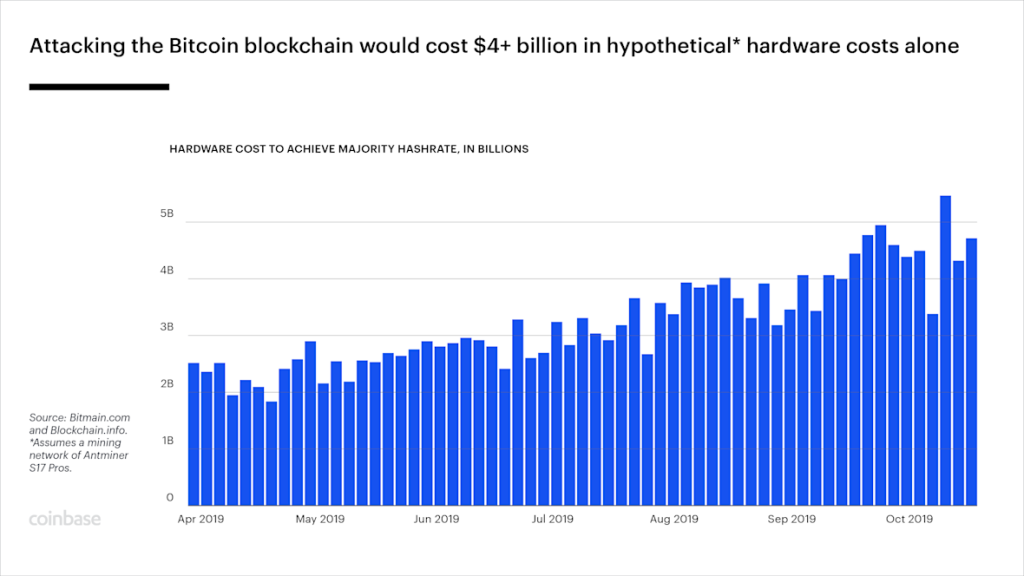
Specialized computers, known as mining rigs, perform the mathematical calculations necessary to verify and record each new transaction. In the early years, even a regular home computer could participate in mining, allowing curious individuals to become miners. Today, however, the required equipment is extremely powerful, specialized, and costly, often managed by companies or large mining pools.
For example, in October 2019, the processing power needed to mine one Bitcoin was roughly 12 trillion times greater than when Satoshi Nakamoto mined the first blocks in January 2009.
The collective computing power of miners is used to maintain the accuracy and security of the ever-growing blockchain ledger. Bitcoin is inseparably tied to the blockchain; every new Bitcoin and every transaction made with existing Bitcoins is recorded on this ledger.
Why Miners Participate in the Network
The Bitcoin network creates incentives for miners through a continuous competition. All mining devices worldwide compete to solve a mathematical problem. Approximately every 10 minutes, a winner is determined, who then adds a new block of validated transactions to the blockchain.
The reward for this competition decreases over time:
- Until May 2020, the reward for each block was 12.5 BTC
- After the halving event, it dropped to 6.25 BTC
- In 2024, following the next halving, the reward will decrease to 3.125 BTC
This mechanism is designed to increase the scarcity of Bitcoin.
Bitcoin’s Value and Divisibility
At the very beginning, Bitcoin had virtually no value. By the end of 2019, its price was around $7,500, and by November 2021, it surpassed $64,000.
As its price rose, high divisibility became one of Bitcoin’s key features. Each Bitcoin can be divided into 8 decimal places (one hundred millionth of a Bitcoin), with the smallest unit called a Satoshi in the Bitcoin community.
Satoshi Nakamoto designed the network so that the total number of Bitcoins will never exceed 21 million. As of December 2023, roughly 1.4 million Bitcoins remain to be mined, and the final Bitcoins are expected to be mined around 2140.
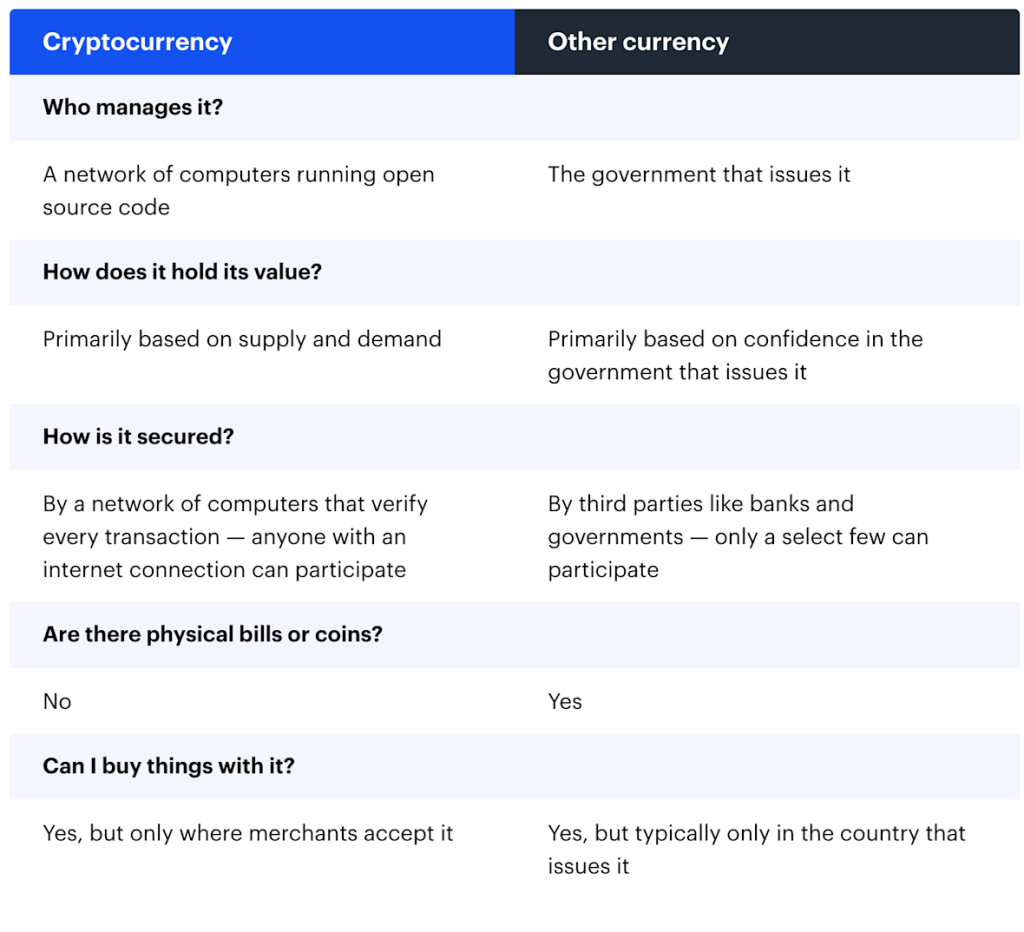
Difference Between Cryptocurrencies and Traditional Currencies
Cryptocurrencies and traditional currencies share some similarities; for example, both can be used to purchase goods and services or be transferred electronically. However, there are significant differences between them.
Bitcoin is the first fully open payment network in the world where anyone with internet access can participate, without the need for banks or intermediary institutions.
Why Does Bitcoin Have Value?
Almost for the same reason traditional currencies have value:
- Bitcoin has proven to be a reliable and practical method for storing value.
- It can be easily exchanged for goods, services, or other assets.
- Bitcoin is scarce, secure, portable (compared to gold), and highly divisible.
- These characteristics make it possible to conduct transactions of any size.
How to Buy Bitcoin
The simplest and safest way to buy Bitcoin is through reputable online exchanges like Coinbase. The main steps are:
- Create an account: Register and complete identity verification on the exchange.
- Link a bank account or card: To purchase Bitcoin using fiat currency.
- Choose the amount of Bitcoin: You can buy a fraction of a Bitcoin.
- Secure storage: Purchased Bitcoin can be stored in the exchange wallet or your personal wallet.
Using this method, even beginners can easily purchase their first units of Bitcoin and enter the world of cryptocurrencies.
The Simplest Way to Buy Bitcoin
The easiest way to buy Bitcoin is through an online exchange like Coinbase. Coinbase simplifies the process of buying, selling, sending, receiving, and storing Bitcoin, allowing you to use it without having to deal directly with concepts like public and private keys.
Buying and Storing Bitcoin Outside Exchanges
If you decide to buy and hold Bitcoin outside an online exchange, the process works as follows:
When someone joins the Bitcoin network, they receive two types of keys:
- Public Key: A long string of letters and numbers that can be thought of like an email address.
- Private Key: Similar to a password, known only to the owner of the asset.
When you buy, send, or receive Bitcoin, the public key acts like a digital safe’s key that gives access to your assets. Anyone can send Bitcoin to your public key, but only the person with the private key can access the Bitcoin stored in that “digital safe.”
Storing Bitcoin (Wallet)
There are multiple ways to store Bitcoin, both online and offline. The simplest method is using a digital wallet, which can be software-based or hardware-based.
If you sell Bitcoin and want to transfer the funds to your bank account, Coinbase makes it nearly as easy as transferring money between two bank accounts. Like regular banking transfers or ATM withdrawals, exchanges such as Coinbase have daily withdrawal limits, and completing the transaction can take a few days to a week.
The simplest way to buy Bitcoin remains using an online exchange like Coinbase.
Key Question: What’s the Difference Between Bitcoin and Blockchain?
All Bitcoin transactions and public keys are recorded on a digital ledger called the blockchain. This ledger is essentially a chronological record of all transactions.
The ledger is identically copied across all computers connected to the Bitcoin network and is continuously verified and secured using massive computing power distributed worldwide.
The blockchain concept is so powerful and flexible that it is now used in applications beyond cryptocurrencies, such as supply chain management.
The term “Bitcoin blockchain” specifically refers to the digital ledger that records Bitcoin transactions and their details.
How to Use Bitcoin
In 2013, an early Bitcoin enthusiast named Laszlo Hanyecz posted on a forum offering 10,000 BTC (worth about $25 at the time) in exchange for two pizzas delivered to his home in Jacksonville, Florida. According to popular accounts, this was the first successful purchase of a physical item with Bitcoin. Today, using Bitcoin is far easier than it was back then.
How Simple Is It to Use Bitcoin?
Making transactions with BTC is not much different from paying with credit or debit cards. Instead of entering card details, you simply enter the payment amount and the recipient’s public key (similar to an email address) in a wallet app.
For in-person payments via mobile or tablet, a QR code is often displayed to simplify the process. Scanning it automatically enters the necessary information into your wallet.
Greater Privacy
One benefit of using Bitcoin is that minimal personal information is required. Your name or address is only needed if you are purchasing a physical item that needs to be shipped.
High Flexibility
What you do with your Bitcoin depends entirely on your goals and interests. For example:
- Convert it to cash via exchanges or Bitcoin ATMs.
- Spend it online or in-person using Bitcoin debit cards.
- Hold part or all of it as part of an investment or savings strategy.
- Donate it to charity or projects you care about.
- If you have substantial funds and dream of space travel, Virgin Galactic, owned by Richard Branson, even accepts Bitcoin for space tourism flights.
Due to the cryptographic nature of the Bitcoin network, transactions are structurally more secure than typical credit or cash transactions.
What Makes Bitcoin a New Kind of Money?
- Bitcoin Is Global: You can send it anywhere in the world as easily as handing over cash. The network never closes, charges no arbitrary fees, and imposes no limits.
- Bitcoin Is Irreversible: Like cash, transactions cannot be reversed by the sender. Credit card or banking transactions can often be reversed months later due to centralized intermediaries, increasing fraud risk and fees.
- Bitcoin Is Private: No bank statement is generated, and unnecessary personal information is not shared with the recipient. Transactions only include Bitcoin addresses and amounts.
- Bitcoin Is Secure: Advanced cryptography makes payments inherently safer than card payments. Sensitive data is not sent over the internet, reducing risks of identity theft or financial information leaks.
- Bitcoin Is Open and Transparent: All network transactions are publicly recorded. This transparency prevents tampering (except in extremely unlikely 51% attack scenarios) or unauthorized changes to Bitcoin supply. Bitcoin’s core software is open-source, and anyone can review the code.
- Bitcoin Is Reliable and Stable: In over a decade, the Bitcoin network has never been successfully hacked. Its open-source, permissionless nature allows cryptography and computer science experts to continuously audit and secure the network.
Where Does Bitcoin Come From?
Bitcoin is created digitally through a process called mining. This is done by a vast, decentralized, peer-to-peer network of computers that continuously verify and secure the blockchain.
Every Bitcoin transaction is recorded in this ledger, and new information is periodically collected into a “block”, which is then added to the chain of previous blocks.